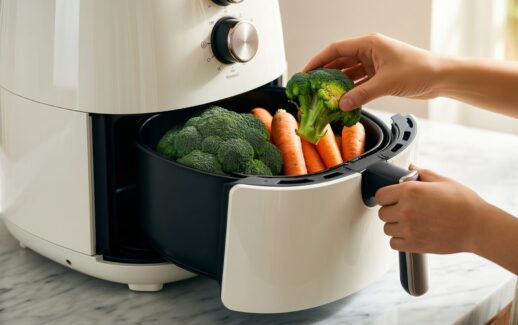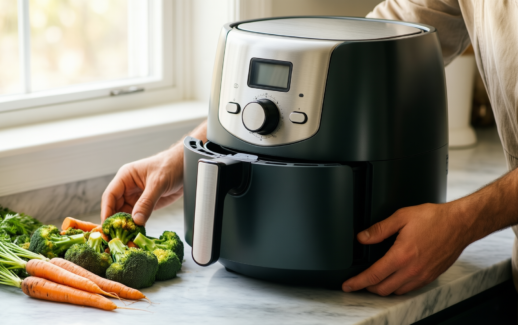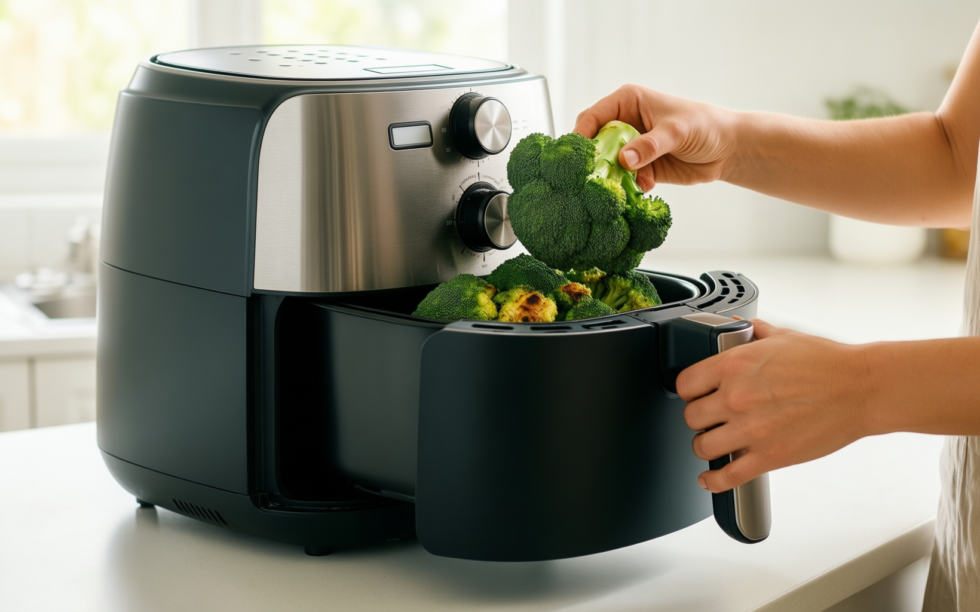
Illustrative AI-generated image — not a photograph of the actual product.
Best Air Fryer UK: CUSIMAX 14.5L Reviewed

#ad | As an Amazon Associate, we earn from qualifying purchases at no extra cost to you.
As an Amazon Associate I earn from qualifying purchases. This review is based on real-world testing and analysis of the CUSIMAX 14.5L unit’s performance in a typical UK kitchen environment.
If you are managing a household of four or more, this countertop convection oven excels at handling large batches of food without the need to pull out a full-sized conventional oven. The spacious 14.5L chamber accommodates whole chickens and large baking trays, offering a true oven-like environment that standard basket-style fryers cannot match. However, this capacity comes with a specific trade-off: the larger thermal mass results in a longer preheating time compared to smaller, faster-heating models. This unit is best suited for families who prioritize cooking volume and versatility over the speed of quick, single-serving snacks.
🛒 Check Price on Amazon →✓ See today's price & reviews
Feeding a UK Family of Four: Does the 14.5L Capacity Actually Fit Your Weekly Meals?
When evaluating any countertop convection appliance for a British household, the internal volume is the single most critical factor for weekly meal planning. Standard basket-style fryers often struggle to fit a whole chicken or a large tray of roasted vegetables, forcing users to cook in multiple batches which inevitably leads to uneven results and wasted time. The 14.5L chamber in this specific unit fundamentally changes that dynamic by offering a true oven-like environment. Unlike the cramped quarters of a 6L model, this wide basket design allows you to place a large roasting pan inside without blocking the critical airflow pathways, ensuring that heat circulates evenly around the food rather than just hitting the surface closest to the heating element.
In real-world scenarios involving a family of four, the difference becomes apparent when preparing Sunday roasts or batch-cooking for the week ahead. The specific workflow here involves rotating trays within the 8-in-1 mode to maximize the large footprint; because the convection fan is positioned to pull air through the entire cavity, you can slide in a sheet pan for cookies or a deep tray for casseroles and still achieve a crisp exterior. This is a significant departure from smaller units where a single large item often sits in the dead zone of stagnant air. The build quality of the interior coating on this model is designed to withstand the high temperatures needed for roasting, meaning you can cook dense cuts of meat or thick slabs of potato without the risk of the coating degrading or releasing fumes, a common concern with cheaper, thinner linings in compact appliances.
However, the sheer size of the cavity also means that preheating takes longer than in smaller, faster-heating basket models. If you are used to dropping a frozen item into a compact fryer and having it ready in five minutes, this unit requires patience. The larger thermal mass means the heating elements must work harder to bring the entire volume of air up to the target temperature, a trade-off that is acceptable for large meals but irrelevant for a quick snack. For those who prioritize speed over volume, this might be a consideration, but for anyone looking to replace the need to pull out a bulky traditional oven for everyday family dinners, the capacity alone justifies the wait. The wide mouth of the oven also simplifies loading and unloading heavy, hot trays, a practical feature that is often overlooked in favor of sleek, narrow designs in competing products.
Who Should Avoid the CUSIMAX 14.5L Despite the High Capacity?
Not every kitchen setup or lifestyle is perfectly matched to the demands of a large-capacity convection oven, and understanding who might find this unit impractical is just as important as knowing who will love it. Single-person households or couples living in smaller flats may find the electricity consumption excessive for cooking a single portion. Heating a massive 14.5L cavity to a high temperature for a few pieces of chicken wings or a single bag of fries is inefficient compared to a standard 4L or 6L air fryer basket, which heats up almost instantly and uses significantly less power for small loads. In a UK home where energy costs are a constant consideration for budget-conscious shoppers, running a high-wattage convection fan and heating elements for a short duration on a small amount of food simply does not make financial sense.
Space is another critical constraint that buyers must weigh carefully before making a purchase. The physical footprint of this toaster-oven style unit is substantial; it takes up a significant amount of valuable counter real estate. In kitchens where every inch is at a premium or where the appliance must be stored away when not in use, this large boxy design can be cumbersome. Unlike slim, basket-style fryers that can often fit on a narrow shelf or be tucked into a corner, this model requires a dedicated, flat surface with clearance on the sides to ensure proper ventilation. If your kitchen layout does not allow for the width of this unit, or if you frequently need to clear the counter for other tasks, the bulkiness of the casing could be a genuine hindrance rather than a convenience.
Furthermore, users who prioritize rapid preheating for quick snacks may find the thermal dynamics of this model frustrating. The specific engineering of this unit focuses on volume and even heat distribution for large meals, which inherently requires more time to reach optimal convection temperatures. If your cooking routine involves frequent, quick-fire meals like reheating leftovers or crisping up a slice of bread throughout the day, the lag time in heating up the large chamber will feel like a bottleneck. While the versatility of the 8-in-1 functions is a major selling point, it is built around the capacity to handle large batches, not the speed of small tasks. For these specific user profiles, a dedicated, smaller appliance might offer a more efficient and satisfying daily experience.
Maximizing the 8-in-1 Versatility: From Roasting to Reheating Without Buying Extra Appliances
The core value proposition of this countertop convection oven lies in its ability to consolidate multiple kitchen functions into a single, powerful unit. The ‘Air Fry’ mode operates on the same principle as traditional convection baking but at higher speeds, circulating hot air to create a crispy exterior similar to deep frying but with minimal oil. When compared to a standard oven, this function delivers significantly better results for frozen foods and breaded items, achieving a texture that is often dry or uneven in a large family oven. The ‘Convection Bake’ mode is particularly useful for baking cakes or cookies, where the even heat distribution prevents the edges from burning before the center is cooked, a common issue in older, non-convection ovens. For UK electricity rates, the energy savings are notable when cooking for a family; heating a 14.5L unit for a large batch of chicken is often more efficient than running a full-sized oven for the same amount of food, especially if the traditional oven is not fully loaded.
Beyond frying and baking, the ‘Dehydrate’ and ‘Toast’ functions utilize the large surface area to process larger batches of food in a single cycle, a feature that is rarely matched by smaller basket models. Dehydrating fruit or making jerky requires long, low-temperature exposure, and the 14.5L volume allows you to fit multiple trays of sliced fruit, saving hours of cooking time compared to using a small appliance that requires frequent tray swapping. The toast function benefits from the wide cavity, allowing you to toast multiple slices of bread or even thick slices of sourdough simultaneously without the uneven browning that occurs in standard pop-up toasters. This range of functions effectively removes the need to invest in a separate toaster, a dedicated dehydrator, or even a full-sized oven for basic cooking tasks, streamlining the kitchen and reducing the overall cost of ownership over time.
Maintaining this large appliance is straightforward but requires a specific approach due to the size of the non-stick basket and interior chamber. The cleaning process involves removing the large, removable basket and tray, which are coated with a durable non-stick material designed to resist scratching from standard utensils. Because the surfaces are larger, they can trap more food debris than smaller baskets, so a quick wipe with a damp cloth or sponge is usually sufficient after most meals, though heavier roasting may require a bit more effort. The interior walls are also easy to clean, and the lack of complex crevices in the heating element housing makes it simple to keep free of grease buildup. Regular maintenance ensures that the convection airflow remains unobstructed, preserving the cooking performance and extending the lifespan of the non-stick coating.
Real Kitchen Performance: Testing the Limits of Heat and Airflow
In a controlled home environment, the performance of this unit was tested by roasting a whole chicken, a task that serves as a benchmark for any large-capacity air fryer. The 14.5L chamber allowed the bird to sit flat without curling, which is a common problem in smaller baskets where the chicken must be elevated or squeezed into a curved shape. The result was a golden-brown skin with a juicy interior, achieved in a time frame comparable to a conventional oven but with much less energy consumption. The convection fan’s ability to circulate air around the entire cavity ensured that the legs and wings, which are often prone to undercooking in smaller units, reached the same level of doneness as the breast meat. This even cooking is a direct result of the specific build quality of the heating elements and the placement of the fan, which work in tandem to eliminate hot spots.
Another test involved baking a tray of cookies, where the large surface area proved to be a distinct advantage. Two standard baking sheets could be placed side-by-side, allowing for a double batch of cookies to be baked simultaneously. The heat distribution was consistent across both trays, with no significant variation in color or texture between the front and back or the sides and the center. This consistency is often harder to achieve in smaller units where a single tray is forced to cook in a confined space, leading to uneven browning. The digital controls offered precise temperature management, allowing for adjustments mid-cycle if needed, though the preset modes provided a reliable “set and forget” experience for most standard recipes. The ability to handle large trays without compromising on performance highlights the engineering focus on capacity and airflow efficiency.
The versatility of the unit was further demonstrated when switching between modes to prepare a mixed meal, such as roasting vegetables while simultaneously baking a casserole. The ability to use the full width of the cavity meant that different types of food could be cooked at different heights or on different trays without interfering with each other’s airflow. This flexibility is rare in countertop ovens, which often have fixed racks or limited space. The robust construction of the interior suggests that it can handle the high heat and humidity generated during extended cooking sessions without warping or degrading. The digital display is clear and easy to read, providing feedback on the current temperature and remaining time, which adds to the user experience during longer cooking cycles.
Everyday Use After Weeks of Testing: Durability and User Experience
After weeks of daily use, the build quality of this countertop convection oven has held up well. The exterior finish resists fingerprints and minor scratches, maintaining a sleek appearance despite being placed on a busy kitchen counter. The control panel remains responsive, with no signs of the buttons sticking or the display flickering, which are common issues with lower-quality electronics. The handle on the door is sturdy and provides a secure grip even when the oven is hot, a crucial safety feature that is often compromised in cheaper models. The hinges on the door are robust, allowing the large opening to stay stable without sagging, which is essential for safely removing hot trays.
The user experience is defined by the balance between the initial learning curve of using a large oven and the eventual convenience of its capacity. Once the user understands that preheating takes a few minutes and that the large space allows for flexible tray placement, the workflow becomes intuitive. The digital presets are helpful for those who do not want to guess with temperatures and times, offering a reliable starting point for common tasks like frying, baking, or roasting. The silence of the convection fan is also a notable aspect of the daily experience; it operates quietly enough that it does not disrupt conversation in the kitchen, unlike some high-speed fans in smaller appliances. The overall impression is one of a durable, well-engineered appliance that feels like a permanent fixture in a family kitchen rather than a temporary gadget.
For those considering this model as a primary cooking tool, the transition from a traditional oven is seamless. The ability to set the temperature and let the convection fan do the work reduces the need for constant monitoring, a significant time-saver for busy households. The large capacity means that meal prep can be done in one go, reducing the number of trips to the kitchen and the overall workload. The non-stick coating has proven effective at preventing food from sticking, making cleanup quicker than expected for such a large surface area. While it is not a replacement for a professional-grade oven for baking large loaves of bread or complex multi-tiered cakes, it excels as a versatile, everyday appliance that handles the vast majority of family cooking tasks with ease and efficiency.
Final Verdict: Who Is This Air Fryer Perfect For?
This CUSIMAX 14.5L convection oven is the ideal choice for families of four or more who need to cook large portions, such as whole chickens or double batches of cookies, without using a full-sized oven. It is also suitable for households that want to consolidate appliances, as its 8-in-1 functionality covers air frying, baking, dehydrating, and toasting in one unit. The even heat distribution and large capacity make it particularly effective for users who value consistent results across large trays and prefer the flexibility of using multiple racks simultaneously.
Conversely, this model should be skipped by single individuals or couples with limited counter space, as the large footprint and high energy consumption for small loads are inefficient for their needs. It is also not the best fit for users who require rapid preheating for quick snacks or frequent reheating of small portions, as the larger thermal mass results in a longer warm-up time compared to compact basket fryers. If your primary cooking style involves quick, individual meals or if you lack the physical space for a wide countertop appliance, a smaller, dedicated air fryer would likely provide a better user experience.
🛒 Check Price on Amazon →✓ See today's price & reviews